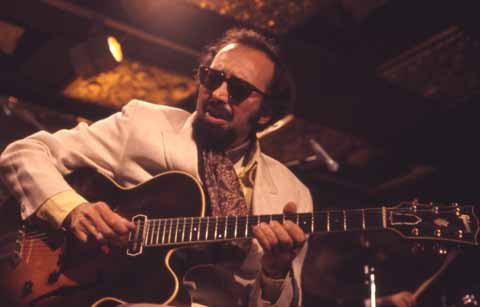
Welcome to my first blog post of 2011. This time round, I have decided to shine the spotlight on the great Richard Thompson.
In Nick Hornby's High Fidelity (required text for music dorks worldwide), the character Dick, in an effort to convert his new female friend in the ways of indie-boy fandom, describes Thompson as "England's finest guitarist". To music nerds like Dick, it is silly even to pause when asked who is the greatest guitarist of all time. While others will plum for one of the Jimmys or Clappers, Richard Thompson just seems to have a very special place in the hearts of many music fans' heart. He is the definition of the alternative guitar hero, the music boffin's choice.
The track above is one from the back catalogue of Fairport Convention, the band where Thompson made his first musical mark. He had grown up, during the 1950s, in a music-appreciative environment, soaking up his Scottish father's native folk ballads and bagpipe tunes, as well as his Django Reinhardt and Les Paul records. Thanks to his sisters, his ears were opened to the energetic sounds of Chuck Berry, Jerry Lee Lewis and Buddy Holly. Combined with a love of the new beat groups of the mid 1960s, young Thompson's precocious guitar style began to take shape. He formed a school covers band with future Stranglers' leader Hugh Cornwell, playing the hits of the day. However, his first serious musical exploits came when he joined the ranks of the fledgling Fairport Convention, a band whose musical outlook was very influenced by the West Coast sounds of The Byrds and Buffalo Springfield. Cover versions made up a big part of their early repertoire. Here is one of their first attempts at an English folk-rock sound.
This track comes from the group's second album, What We Did On Our Holidays, an album which marked the transition from the West Coast leanings of the group to a far more British folk influenced sound. Around this time, Richard began to refine his song-writing talent with tunes like Genesis Hall and Meet On The Ledge. Throughout this period also, Richard Thompson's exquisite guitar-work shone through, at time conjuring up the sounds of droning bagpipes and razor sharp fiddle, as well as the odd Django quote or James Burton twang. He is another track from Fairport's most celebrated work, Liege & Lief.
Thompson decided to leave Fairport in 1971, choosing to pursue a solo career and session work. He worked on albums for John Martyn, Sandy Denny and Nick Drake, as well as releasing the idiosyncratic solo debut, Henry The Human Fly. This album gave the world a first glimpse at Thompson skewed and humorous, yet sometimes bleak, world-view. However, while Thompson's first foray into solo territory was at best, misunderstood, or at worst, ignored, his musical partnership with his new wife, Linda Peters, would have critics and fans swooning for the next decade. Linda would become the voice for Richard's masterful tunes. Their debut, I Want To See The Bright Lights Tonight, was a classic, its songs full of stoical imagery, Victorian gloom and somber tales. This slightly pessimistic view of the world gave the Thompsons an ill-found reputation for miserabilism. On the contrary, their concerts from the period were noted for Linda's soulful vocals and Richard's capricious, off-the-cuff remarks, as well as some truly inspired guitar-work. Here is the legendary live version of The Calvary Cross, a vehicle for Richard's thrilling playing. Please, play this mother loud!
The Thompson released two more albums, Hokey Pokey and Pour Down Like Silver, both to universal praise. It was around this period that Richard and Linda convert to Sufism, a mystic-based branch of Islam. Many have speculated as to how much this religious conversion affected Thompson's writing output. What is clear though is that Thompson felt he and his young family needed to move away from the music industry for a period in the late 1970s. He and Linda would slowly re-emerged in the wider public's eye with two albums in the late 1970s, only to hit their creative highpoint with 1982's Shoot Out The Lights. Sadly, martial problems would come to the surface during the pair's US tour of the same year, with a divorce following. Shoot Out The Lights remains one of Richard Thompson's great achievements. Here is the closing track, Wall Of Death.
After parting ways with Linda, Richard released a string of solo records during the 1980s and early 1990s that showcased his growing songwriting talent and ever-inspired guitar playing. Many classic Thompson tunes come from this period, She Twists The Knife Again, Tear Stained Letter, Waltzing's For Dreamers, Al Bowlly's In Heaven and many others. Here is Thompson's most requested number in recent years, from 1991's Rumor And Sigh.
As Thompson continued to produce great music in the 1990s and 2000s, he began to move further away from the mainstream. He now, instead of being contracted to a big record label, produces his own work and licenses it to small independents for distribution. He boasts an extremely dedicated following who follow their hero's output closely. His songwriting seems to get better and better with every release. Here is a belter of a track from Richard's 2007 album, Sweet Warrior, detailing the plight of a US soldier in Iraq.
One of Richard's more unusual and rewarding projects of the last decade is his 1000 Years Of Popular Music stage-show. Prompted by the turn-of-the-millennium fascination with documenting the greatest songs ever written, Thompson set out to chart the evolution of the popular song form throughout the centuries in an entertaining show. In each show, he includes material such as fugal tunes from medieval monks, Renaissance dances, Gilbert & Sullivan operetta songs, Victorian Music Hall, jazz standards, country & western songs, rock 'n' roll jukebox hits, even the odd Britney Spears classic.
My love for Richard's playing grows with ever new tune of his I hear. The man seems to be a bottomless pit of inspiring licks, jaw-dropping solos and consistently great songwriting. His guitar style is true unique, and very rarely strays into the blues-box cliches of other players. The main characteristic of Richard's style is his use of hybrid picking, a combination of pick and fingers to construct highly technical licks and riffs. He uses this technique for both electric to acoustic work. His electric tone is sharp, spiky, clear and jagged, while his acoustic tone is round, plummy and warm. He can enliven the most basic folk tune with a flurry of diverse licks that will leave any guitar-lover breathless. He is a pure musician, taking innumerable influences from many different sources and distilling them into a truly individual style. He remains a wondrous musical talent, hopefully with many years of rippin' solos left in him. Just like this one from his latest offering, Dream Attic.
Recommended Listening: Richard & Linda Thompson - I Want To See The Bright Lights Tonight
http://allmusic.com/album/i-want-to-see-the-bright-lights-tonight-r20101
Some Choice Thompson Tunes: She Twists The Knife Again (Across a Crowded Room), The Money Shuffle (Dream Attic), Waltzing's For Dreamers (Amnesia)
Shining the spotlight on those forgotten players.
Showing posts with label 1960s. Show all posts
Tuesday, January 4, 2011
Monday, November 8, 2010
James Burton: Chicken Pickin' Master
James Burton was just 18 years old when he lay down that iconic riff on rockabilly star Dale Hawkins' biggest hit. He had begun playing guitar early in his childhood, going semi-pro at 13. He soon moved west to Los Angeles and started finding work in the studios, playing on some of the most enduring rock 'n' roll hits of the late 1950s and early 1960s. He joined teen idol Ricky Nelson's band in 1958, playing smokin' lead on his records until 1967. Here is one of Ricky's biggest hits.
In his time on the mid 1960s L.A. session circuit, James played guitar for The Everly Brothers, "Mama" Cass Elliot, Randy Newman, Joni Mitchell, Buffalo Springfield and The Monkees. He was a regular member of the house-band of pop show Shindig. Country legends Merle Haggard and Buck Owens utilised his chicken-pickin' Telecaster sound on some of their mid 1960s records, His picking style, a highly-skilled combination of plectrum and finger plucking, known as hybrid picking, is the standard left-hand technique now employed by country players. Also, his use of the Fender Telecaster with a razor-sharp clean tone created the archetypal twangy country electric guitar sound we know today. Here is some of that good ol' country twang in action.
His most high profile gig came in 1969. Elvis Presley, basking in a post-'68 Comeback Special resurgence in popularity, was easing back into the live environment he had forsaken in favour of schlock flicks and novelty records. He needed a new band to back him in the Las Vegas hotel venues and concert halls that would soon be his home. James Burton, fresh from leaving Ricky Nelson, accepted the gig and set about putting together the band for Presley. Along with drummer Ronnie Tutt, rhythm guitarist John Wilkinson, pianists Glen D. Hardin and Larry Muhoberac and bassist Jerry Scheff, he formed the core Elvis group, the TCB (Takin' Care Of Business) Band. This group backed The King until his untimely death in 1977. While not regarded as Presley's finest musical years, Burton's rippin' Telecaster playing would always shine through even the most schmaltzy song choices Elvis would throw at him. Here, however, is the exception to the rule. This tune just plain rocks. James is in the back somewhere, sporting his signature Pink Paisley Tele.
In between rockin' out with The King, James was a vital element in the formation of country rock. When Gram Parson left that genre's foremost pioneers, The Flying Burritos Brothers, he called upon Burton to add a even more countrified sound to his new solo material. James, being a good man to form a band around, formed the core of Parson's studio band, playing on both of Gram's influential solo albums, GP and Grievous Angel. Here is one of my favourite Gram solo tracks."Pick it for me, James!"
The harmony singer on that track was one Emmylou Harris. After Gram's death in 1973, Emmylou formed the Hot Band, of which James was a founding member. He played on her first two solo outings, Pieces Of The Sky and Elite Hotel. Here they are on The Old Grey Whistle Test in 1976.
James Burton continued to work with various legends throughout the late 1970s and 1980s. MOR superstar John Denver had him in his touring band in this period. The other Elvis, Costello that is, asked him to play on his first post-Attractions album, 1986's country-tinged King Of America, as well as a variety of other future projects. Roy Orbison, on the comeback trail in the late 1980s, asked Burton to be part of his Black And White Night TV special. James, alongside his TCB bandmates, fitted in nicely with the galaxy of stars that turned out to back The Big O on that gig. Here is a sample of this fine concert. See how many familiar faces you recognise.
As you can see, if it's country twang and consistently face-melting playing you want, James Burton is your man. The unassuming mustachioed gentleman, in the background somewhere, will hopefully continue to twang that Tele for many more years. Here is one final track, uniting the two Elvises in one rockin' little package. Happy Twangin' y'all!
Recommended Listening: GP - Gram Parsons - 1973
http://allmusic.com/album/gp-r14895
Some James Burton Twangy Classics: Susie-Q - Dale Hawkins, Boulder To Birmingham - Emmylou Harris, Brass Buttons - Gram Parsons
Sunday, September 19, 2010
John Cipollina: Quicksilver’s Whammy Bar King
The psychedelic era produced it’s fair share of remarkable guitarists. Jimi Hendrix invigorated the blues with a cosmic twist. Jerry Miller of Moby Grape injected some country licks into his band’s early power pop masterpieces. Jerry Garcia and The Grateful Dead captivated the hippy generation with seemingly endless jamming marathons in legendary auditoriums like The Fillmore. One of the most singular talents and instantly recognisable players to emerge from this era was Quicksilver Messenger Service’s John Cipollina.
John Cipollina and Quicksilver Messenger Service were one of the house bands of the San Francisco acid rock scene. Their music is indubitably linked with this period, with flower-child lyrics and extended space-blues jams. The guitar playing of Cipollina was what really set them apart from the crowd though. The best phrase to describe his playing is left-of-centre. His style was a striking amalgamation of blues, jazz, classical and thumb-picked rock, all delivered with extensive wiggling of his Gibson SG’s whammy bar. His intense vibrato style would influence many future guitarists like Tom Verlaine, Nels Cline and Richard Thompson. Check out this video from Cipollina’s solo career. Please excuse the mooners near the start of video, they mean no harm.
Quicksilver is not one of the more celebrated bands from this period. This could be down to their inconsistent recorded legacy. Having said that, the band did produce some interesting music that is worth a listen. What makes most of their stuff interesting for me is Cipollina’s idiosyncratic guitar style, incorporating jazz and classical licks with a unique blues-rock vocabulary. He is one of Quicksilver’s signature tunes, Gold and Silver. The use of unusual time signatures and elongated instrumental sections make it an early example of jazz-rock.
Recommended Listening: Happy Trails – Quicksilver Messenger Service
http://allmusic.com/cg/amg.dll?p=amg&sql=10:g9fpxqt5ld6e
Some Top Quicksilver Moments: Who Do You Love, Mona, Gold and Silver.
Labels:
1960s,
fingerstyle,
lead,
psychedelic,
rock,
SG,
whammy bar
Saturday, September 11, 2010
Barney Kessel: The Wrecking Crew's Chief Axeman
Barney Kessel (1923 – 2004) is one of those players that millons have heard, yet few would recognise. At least they think they don't recognise him. You know the intro to Wouldn't It Be Nice, right? Y'know, "jingle, jingle, jingle, etc"? That's Barney. Those cool licks in Julie London's Cry Me A River? That's Barney. The riff on I've Got You Babe by Sonny & Cher? That's Barney.
Barney Kessel was one of the first post-Charlie Christian bebop guitarists to make big waves on the jazz scene. He appeared on records by Charlie Parker, Ella Fitzgerald, Sonny Rollins and Billie Holiday. He also held the notoriously high-tempo guitar chair in the Oscar Peterson Trio during the early 1950s. In parallel to this, he recorded albums under his own name, featuring selections from the Great American Songbook reworking in his own unique style.
In the 1960s, he found steady work as an in-demand session guitarist in the Los Angeles recording world. It is there that he worked on dates for The Monkees, Phil Spector and The Beach Boys. In the 1970s, he presented seminars on the art of guitar playing and even ran his own guitar shop in L.A. for a time.
What I really like about Barney's jazz playing is that, while it is sophisticated and complex, he stills retains a great respect for the melody. This is especially true of his intrepretations of popular tunes, where he combines piano-like block chords and elegant single lines into an original presentation of the standard. By doing this, he keeps the songs fresh with inventive embellishments. Listen to his version of that old chestnut, Misty.
While Barney should be remembered as an innovative jazzer, his contribution to the popscene of the 1960s is worth considering too. He is a class act, worth further investigation.
Recommend Listening: The Poll Winners (1957)
http://www.allmusic.com/cg/amg.dll?p=amg&sql=10:wxfpxqrgldde
Some Standout Barney Tracks: Satin Doll, A Foggy Day, Love Is Here To Stay
Labels:
1940s,
1950s,
1960s,
hollowbody,
jazz,
session player
Subscribe to:
Posts (Atom)