Welcome to my first blog post of 2011. This time round, I have decided to shine the spotlight on the great Richard Thompson.
In Nick Hornby's High Fidelity (required text for music dorks worldwide), the character Dick, in an effort to convert his new female friend in the ways of indie-boy fandom, describes Thompson as "England's finest guitarist". To music nerds like Dick, it is silly even to pause when asked who is the greatest guitarist of all time. While others will plum for one of the Jimmys or Clappers, Richard Thompson just seems to have a very special place in the hearts of many music fans' heart. He is the definition of the alternative guitar hero, the music boffin's choice.
The track above is one from the back catalogue of Fairport Convention, the band where Thompson made his first musical mark. He had grown up, during the 1950s, in a music-appreciative environment, soaking up his Scottish father's native folk ballads and bagpipe tunes, as well as his Django Reinhardt and Les Paul records. Thanks to his sisters, his ears were opened to the energetic sounds of Chuck Berry, Jerry Lee Lewis and Buddy Holly. Combined with a love of the new beat groups of the mid 1960s, young Thompson's precocious guitar style began to take shape. He formed a school covers band with future Stranglers' leader Hugh Cornwell, playing the hits of the day. However, his first serious musical exploits came when he joined the ranks of the fledgling Fairport Convention, a band whose musical outlook was very influenced by the West Coast sounds of The Byrds and Buffalo Springfield. Cover versions made up a big part of their early repertoire. Here is one of their first attempts at an English folk-rock sound.
This track comes from the group's second album, What We Did On Our Holidays, an album which marked the transition from the West Coast leanings of the group to a far more British folk influenced sound. Around this time, Richard began to refine his song-writing talent with tunes like Genesis Hall and Meet On The Ledge. Throughout this period also, Richard Thompson's exquisite guitar-work shone through, at time conjuring up the sounds of droning bagpipes and razor sharp fiddle, as well as the odd Django quote or James Burton twang. He is another track from Fairport's most celebrated work, Liege & Lief.
Thompson decided to leave Fairport in 1971, choosing to pursue a solo career and session work. He worked on albums for John Martyn, Sandy Denny and Nick Drake, as well as releasing the idiosyncratic solo debut, Henry The Human Fly. This album gave the world a first glimpse at Thompson skewed and humorous, yet sometimes bleak, world-view. However, while Thompson's first foray into solo territory was at best, misunderstood, or at worst, ignored, his musical partnership with his new wife, Linda Peters, would have critics and fans swooning for the next decade. Linda would become the voice for Richard's masterful tunes. Their debut, I Want To See The Bright Lights Tonight, was a classic, its songs full of stoical imagery, Victorian gloom and somber tales. This slightly pessimistic view of the world gave the Thompsons an ill-found reputation for miserabilism. On the contrary, their concerts from the period were noted for Linda's soulful vocals and Richard's capricious, off-the-cuff remarks, as well as some truly inspired guitar-work. Here is the legendary live version of The Calvary Cross, a vehicle for Richard's thrilling playing. Please, play this mother loud!
The Thompson released two more albums, Hokey Pokey and Pour Down Like Silver, both to universal praise. It was around this period that Richard and Linda convert to Sufism, a mystic-based branch of Islam. Many have speculated as to how much this religious conversion affected Thompson's writing output. What is clear though is that Thompson felt he and his young family needed to move away from the music industry for a period in the late 1970s. He and Linda would slowly re-emerged in the wider public's eye with two albums in the late 1970s, only to hit their creative highpoint with 1982's Shoot Out The Lights. Sadly, martial problems would come to the surface during the pair's US tour of the same year, with a divorce following. Shoot Out The Lights remains one of Richard Thompson's great achievements. Here is the closing track, Wall Of Death.
After parting ways with Linda, Richard released a string of solo records during the 1980s and early 1990s that showcased his growing songwriting talent and ever-inspired guitar playing. Many classic Thompson tunes come from this period, She Twists The Knife Again, Tear Stained Letter, Waltzing's For Dreamers, Al Bowlly's In Heaven and many others. Here is Thompson's most requested number in recent years, from 1991's Rumor And Sigh.
As Thompson continued to produce great music in the 1990s and 2000s, he began to move further away from the mainstream. He now, instead of being contracted to a big record label, produces his own work and licenses it to small independents for distribution. He boasts an extremely dedicated following who follow their hero's output closely. His songwriting seems to get better and better with every release. Here is a belter of a track from Richard's 2007 album, Sweet Warrior, detailing the plight of a US soldier in Iraq.
One of Richard's more unusual and rewarding projects of the last decade is his 1000 Years Of Popular Music stage-show. Prompted by the turn-of-the-millennium fascination with documenting the greatest songs ever written, Thompson set out to chart the evolution of the popular song form throughout the centuries in an entertaining show. In each show, he includes material such as fugal tunes from medieval monks, Renaissance dances, Gilbert & Sullivan operetta songs, Victorian Music Hall, jazz standards, country & western songs, rock 'n' roll jukebox hits, even the odd Britney Spears classic.
My love for Richard's playing grows with ever new tune of his I hear. The man seems to be a bottomless pit of inspiring licks, jaw-dropping solos and consistently great songwriting. His guitar style is true unique, and very rarely strays into the blues-box cliches of other players. The main characteristic of Richard's style is his use of hybrid picking, a combination of pick and fingers to construct highly technical licks and riffs. He uses this technique for both electric to acoustic work. His electric tone is sharp, spiky, clear and jagged, while his acoustic tone is round, plummy and warm. He can enliven the most basic folk tune with a flurry of diverse licks that will leave any guitar-lover breathless. He is a pure musician, taking innumerable influences from many different sources and distilling them into a truly individual style. He remains a wondrous musical talent, hopefully with many years of rippin' solos left in him. Just like this one from his latest offering, Dream Attic.
Recommended Listening: Richard & Linda Thompson - I Want To See The Bright Lights Tonight
http://allmusic.com/album/i-want-to-see-the-bright-lights-tonight-r20101
Some Choice Thompson Tunes: She Twists The Knife Again (Across a Crowded Room), The Money Shuffle (Dream Attic), Waltzing's For Dreamers (Amnesia)
Shining the spotlight on those forgotten players.
Showing posts with label stratocaster. Show all posts
Tuesday, January 4, 2011
Sunday, September 26, 2010
Adrian Belew: Lion Tamer Extraordinaire
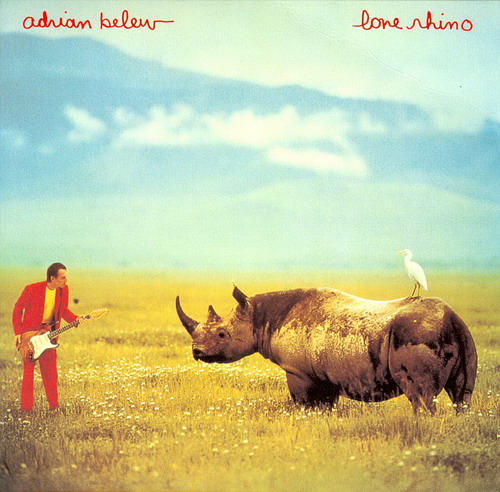
There are players who wow us with great feats of speed and endurance. There are those who blind us with their melodic erudition. Then there are those whose musical outpourings of pure emotion knock us for ten. Finally there are those who make us giggle by making funny noises with their guitar. Adrian Belew falls into the latter category. That is not to take away from Mr. Belew's obvious instrumental talents. However, any person who can make elephant noises on their guitar is eh-ok in my book.
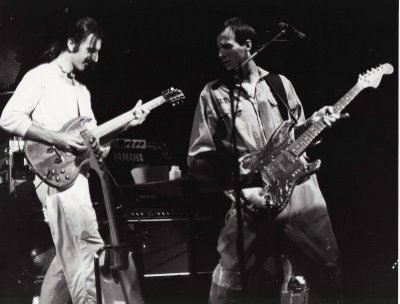
In 1960s Kentucky, Adrian Belew was a teenage guitar obsessive listening to the experimental rock sounds of Hendrix, Beck and The Beatles. He began to emulate their studio-created sounds on his solitary electric guitar, soon developing a very personal and eccentric style. In the late 1970s, he was spotted by Frank Zappa playing covers in a bar band. Zappa offered him a place in his touring act, which the eager Belew accepted. He describes his short tenure with the notoriously demanding Zappa as a crash course in music theory.
The experience he gained from Frank served him well when he joined David Bowie's band for the Heroes tour of 1978, subsequently added demented lead guitar and backing vocals to Bowie's Lodger album of 1979, the last of his Berlin Trilogy. Here is a select cut from that album, a perfect encapsulation of Belew's freaky noise workouts.
Talking Heads were the next legends to come knocking. He joined them in the midst of the arduous recording sessions that produced Remain In Light. Tracks like The Great Curve are taken into another rhelm thanks to Belew's heavily-processed solos and led to his addition to the expanded touring version of Talking Heads. He also featured on the band's off-shoot project, Tom Tom Club.
In the early 1980s, he joined the act with whom he is most recognised. Belew and Robert Fripp had both worked on albums by Bowie, but never met. They eventually bumped into each other at a Steve Reich concert (why doesn't this surprise me?). They hit it off, and began a new project together, Indiscipline. This would eventually morph into a new lineup of Fripp's legendary prog godfathers, King Crimson. This new lineup would resemble some bizarre Talking Heads tribute act rather than the heavy-riffing art rock monsters of the mid 1970s. Here is sample of this new direction, complete with Belew's animal noise guitar.
As well as serving as King Crimson's frontman for nearly three decades, Belew has been a popular session man. Pau Simon, Joe Cocker, Cyndi Lauper and even Captain Kirk himself, William Shatner have requested his services. He has also released a steady stream of Beatles-inspired solo albums and noise experiments.
As you have seen from these clips, Belew is naturally drawn towards bizarre noises and outlandish sounds. He seems to take great glee in washing over conventional pop songs with his distinct guitar style, the weirder the better. To finish, some more animal noises. I never get tired of this.
Recommended Listening: King Crimson - Indiscipline
http://allmusic.com/cg/amg.dll?p=amg&sql=10:kvfrxquald0e
Some Choice Belew Craziness: Oh Daddy (Solo Hit), Flakes (Frank Zappa - Sheik Yerbouti), I'm Down (Beatles Cover)
In 1960s Kentucky, Adrian Belew was a teenage guitar obsessive listening to the experimental rock sounds of Hendrix, Beck and The Beatles. He began to emulate their studio-created sounds on his solitary electric guitar, soon developing a very personal and eccentric style. In the late 1970s, he was spotted by Frank Zappa playing covers in a bar band. Zappa offered him a place in his touring act, which the eager Belew accepted. He describes his short tenure with the notoriously demanding Zappa as a crash course in music theory.
The experience he gained from Frank served him well when he joined David Bowie's band for the Heroes tour of 1978, subsequently added demented lead guitar and backing vocals to Bowie's Lodger album of 1979, the last of his Berlin Trilogy. Here is a select cut from that album, a perfect encapsulation of Belew's freaky noise workouts.
Talking Heads were the next legends to come knocking. He joined them in the midst of the arduous recording sessions that produced Remain In Light. Tracks like The Great Curve are taken into another rhelm thanks to Belew's heavily-processed solos and led to his addition to the expanded touring version of Talking Heads. He also featured on the band's off-shoot project, Tom Tom Club.
In the early 1980s, he joined the act with whom he is most recognised. Belew and Robert Fripp had both worked on albums by Bowie, but never met. They eventually bumped into each other at a Steve Reich concert (why doesn't this surprise me?). They hit it off, and began a new project together, Indiscipline. This would eventually morph into a new lineup of Fripp's legendary prog godfathers, King Crimson. This new lineup would resemble some bizarre Talking Heads tribute act rather than the heavy-riffing art rock monsters of the mid 1970s. Here is sample of this new direction, complete with Belew's animal noise guitar.
As well as serving as King Crimson's frontman for nearly three decades, Belew has been a popular session man. Pau Simon, Joe Cocker, Cyndi Lauper and even Captain Kirk himself, William Shatner have requested his services. He has also released a steady stream of Beatles-inspired solo albums and noise experiments.
As you have seen from these clips, Belew is naturally drawn towards bizarre noises and outlandish sounds. He seems to take great glee in washing over conventional pop songs with his distinct guitar style, the weirder the better. To finish, some more animal noises. I never get tired of this.
Recommended Listening: King Crimson - Indiscipline
http://allmusic.com/cg/amg.dll?p=amg&sql=10:kvfrxquald0e
Some Choice Belew Craziness: Oh Daddy (Solo Hit), Flakes (Frank Zappa - Sheik Yerbouti), I'm Down (Beatles Cover)
Sunday, September 12, 2010
Funky Cuts, Pt. 1: Eddie Hazel: P-Funk’s Fuzzmeister
I turned to my sibling Declan for our next entry. He’s the funk fan amongst us and has chosen that acid-fried Strat freak, Eddie Hazel. The P-Funk collective, consisting of Funkadelic & Parliament, was bandleader George Clinton’s distilled concept of the ultimate funk act. Clinton believes that a life without “The Fonk” (I am using the vernacular here) is a life not worth bothering with. “The Fonk” is the answer and the solution to all of life’s worries and strife. The P-Funk universe has played host to a number of colourful and talented individuals over the years. These include bass legend, and permanent inhabitant of “The One”, Bootsy Collins, keyboard maestro Bernie Worrell, and nappy-wearing musical director Garry Shider. For guitarists though, the mysterious man in the bug-eye shades and occasional cape manhandling his Fender Stratcaster is the focal of our interest. Dear cats and kittens, I give you Eddie Hazel.
Eddie first came in contact with George Clinton in the late 1960s, when the young guitar hotshot joined Clinton’s Parliaments, an up-and-coming soul combo based in Plainfield, New Jersey. This act eventually morphed into Funkadelic, losing the matching suits and dance routines along the way and gaining a more psychedelic rock sound and look. Combining the spaced-out rock of Jimi Hendrix and Frank Zappa with the burgeoning funk of James Brown and Sly Stone, Clinton had created an outfit that could jam like a rock band, as well as lay down the groove like no one else.
Eddie Hazel was key to the early Funkadelic sound. He co-wrote legendary P-Funk tunes like Free Your Mind And Your Ass Will Follow, Standing On The Verge Of Getting It On and Ret Hot Mama. His screaming, echo-drenched fuzz guitar solos washed over these tunes like a psychedelic blanket of stars. His signature tune is, without a doubt, is Maggot Brain, the title track of Funkadelic’s 1971 magnum opus. The track is, basically, a ten-minute guitar solo, with only sounds of wars and a lightly plucked rhythm guitar to accompany it. The legend goes that Hazel was locked into the studio and told to play like his mother just died. Did he achieve the desired effect? You be the judge.
Eddie, as well as recording a fine solo album “Game, Dames and Guitar Thangs”, continued to contribute to various P-Funk related recordings throughout the 1970s and 1980s until his untimely death in 1992. What I like most about his playing is that he seems to be taking a great sound (In my opinion, Hendrix’s Band Of Gypsies record) and running with it. That is not to say Hazel was a mere Hendrix copyist. Rather he took up the torch of insane funky guitar soloing for a new generation, putting his own stamp on the sound as he went. He influenced near contemporaries like Ernie Isley of The Isley Brothers and Ron Asheton of The Stooges, as well as modern funksters like Prince. If you are a fan of rock music, give Eddie and Funkadelic a try. Consider them a gateway drug into the murky world of “The Fonk”
Recommend Listening: Funkadelic - Maggot Brian (1971)
Some Choice Hazel Grooves: I Wanna Know if it’s Good to You, Red Hot Mama, Funky Dollar Bill (All Funkadelic tunes)
Please do check back soon for some more Funky Cuts.
Labels:
1970s,
funk,
Funky Cuts,
guitar freaks,
lead,
psychedelic,
soul,
stratocaster
Subscribe to:
Posts (Atom)