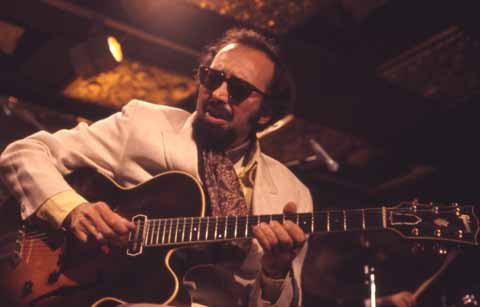
James Burton was just 18 years old when he lay down that iconic riff on rockabilly star Dale Hawkins' biggest hit. He had begun playing guitar early in his childhood, going semi-pro at 13. He soon moved west to Los Angeles and started finding work in the studios, playing on some of the most enduring rock 'n' roll hits of the late 1950s and early 1960s. He joined teen idol Ricky Nelson's band in 1958, playing smokin' lead on his records until 1967. Here is one of Ricky's biggest hits.
In his time on the mid 1960s L.A. session circuit, James played guitar for The Everly Brothers, "Mama" Cass Elliot, Randy Newman, Joni Mitchell, Buffalo Springfield and The Monkees. He was a regular member of the house-band of pop show Shindig. Country legends Merle Haggard and Buck Owens utilised his chicken-pickin' Telecaster sound on some of their mid 1960s records, His picking style, a highly-skilled combination of plectrum and finger plucking, known as hybrid picking, is the standard left-hand technique now employed by country players. Also, his use of the Fender Telecaster with a razor-sharp clean tone created the archetypal twangy country electric guitar sound we know today. Here is some of that good ol' country twang in action.
His most high profile gig came in 1969. Elvis Presley, basking in a post-'68 Comeback Special resurgence in popularity, was easing back into the live environment he had forsaken in favour of schlock flicks and novelty records. He needed a new band to back him in the Las Vegas hotel venues and concert halls that would soon be his home. James Burton, fresh from leaving Ricky Nelson, accepted the gig and set about putting together the band for Presley. Along with drummer Ronnie Tutt, rhythm guitarist John Wilkinson, pianists Glen D. Hardin and Larry Muhoberac and bassist Jerry Scheff, he formed the core Elvis group, the TCB (Takin' Care Of Business) Band. This group backed The King until his untimely death in 1977. While not regarded as Presley's finest musical years, Burton's rippin' Telecaster playing would always shine through even the most schmaltzy song choices Elvis would throw at him. Here, however, is the exception to the rule. This tune just plain rocks. James is in the back somewhere, sporting his signature Pink Paisley Tele.
In between rockin' out with The King, James was a vital element in the formation of country rock. When Gram Parson left that genre's foremost pioneers, The Flying Burritos Brothers, he called upon Burton to add a even more countrified sound to his new solo material. James, being a good man to form a band around, formed the core of Parson's studio band, playing on both of Gram's influential solo albums, GP and Grievous Angel. Here is one of my favourite Gram solo tracks."Pick it for me, James!"
The harmony singer on that track was one Emmylou Harris. After Gram's death in 1973, Emmylou formed the Hot Band, of which James was a founding member. He played on her first two solo outings, Pieces Of The Sky and Elite Hotel. Here they are on The Old Grey Whistle Test in 1976.
James Burton continued to work with various legends throughout the late 1970s and 1980s. MOR superstar John Denver had him in his touring band in this period. The other Elvis, Costello that is, asked him to play on his first post-Attractions album, 1986's country-tinged King Of America, as well as a variety of other future projects. Roy Orbison, on the comeback trail in the late 1980s, asked Burton to be part of his Black And White Night TV special. James, alongside his TCB bandmates, fitted in nicely with the galaxy of stars that turned out to back The Big O on that gig. Here is a sample of this fine concert. See how many familiar faces you recognise.
As you can see, if it's country twang and consistently face-melting playing you want, James Burton is your man. The unassuming mustachioed gentleman, in the background somewhere, will hopefully continue to twang that Tele for many more years. Here is one final track, uniting the two Elvises in one rockin' little package. Happy Twangin' y'all!

http://allmusic.com/album/gp-r14895
Some James Burton Twangy Classics: Susie-Q - Dale Hawkins, Boulder To Birmingham - Emmylou Harris, Brass Buttons - Gram Parsons