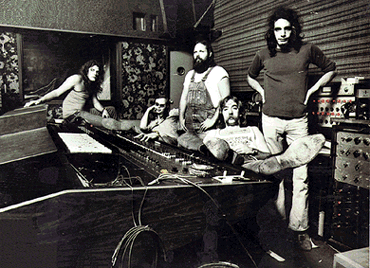
This latest blog posting will be covering a group of players very dear to this reporter's heart. The music of Steely Dan in the 1970s, as well as being some of the most melodic and aurally-satisfying pop music one can come upon, can be seen as a potted history of the electric guitar. Across a series of seven long players, Messrs Becker and Fagen provided the platform for a host of the era's axe-wielders to show off their enviable skills. What follows is an brief introduction to some of these talented muthafuckas. Let us begin with a familiar air.
Steely Dan began in New York as a songwriting vehicle for two slightly snobby, highly-talented, jazz-obsessed misfits, Walter Becker and Donald Fagen. Both had gained experiences working in the lower echelons of the Brill Building, the legendary songwriting factory that produced most of the iconic pop tunes of the 1960s. Having grown tired of the Brill Building slog, the two writers hooked up with the precocious jazz guitarist, Denny Dias. Pretty soon though, Becker and Fagen got songwriting work on the West Coast, only calling on Dias when this work dried up. It is in Los Angeles that Steely Dan really came together, with Jeff 'Skunk' Baxter and Jim Hodder joining on guitar and drums respectfully. With temporary lead vocalist David Palmer, the group recorded their 1972 debut, Can't Buy A Thrill. Even at this early stage, Becker and Fagen's perfectionist tenancies would come to the fore, with the employment of session-head Elliot Randall to rip it up on tracks like Reelin' In The Years and this next one when Baxter or Dias was not cutting the mustard.
After the release of Can't Buy A Thrill, Steely Dan went on the road. However, it soon became apparent that the natural habitat for Becker and Fagen's sarky material for the foreseeable would be air-conditioned L.A. studios, full to the brim with the latest in recording technology. By 1974's Pretzel Logic, it was also clear that they would be handpicking instrumentalists to suit their songs, rather than depending on a consistent band lineup. While they would employ Denny Dias and his formidable jazzy chops on future albums like The Royal Scam and Aja, guitar wildman 'Skunk' Baxter and his winning handlebar mustache was shown the door. He would find himself part of another band of West Coast smooth merchants, The Doobie Brothers. Here is one of Skunk's last hurrahs with the Dan. Remember him like this, guitar nuts.
For good measure, he is a track that showcases Dias and Skunk's contrasting solos styles. Dias could out-bop any jazzhead you care to name, while Baxter was a rock 'n' roll animal, injecting the Dan's music with some welcomed fuzztone. Denny goes first while Skunk takes the outro.
Stay tuned kids for some more Dan-related postings in the future. G'Luck.
Recommended Listening: Countdown To Ecstacy (1973)
http://allmusic.com/album/countdown-to-ecstasy-r18941
Some Great Early Dan Guitar Highlights: The Boston Rag (Countdown To Ecstacy), My Old School (Countdown To Ecstacy), Parker's Band (Pretzel Logic)
Shining the spotlight on those forgotten players.
Tuesday, October 19, 2010
Monday, October 11, 2010
Underground Rock Warriors, Pt. 1: J Mascis
This week's post is courtesy of a suggestion by my little brother Stephen. Being the alt rock fan that he is, he has gone for Dinosaur Jr's head honcho J Mascis.
Joseph Mascis is a native of the small college town Amherst, Massachusetts. In the early 1980s, he became exposed to the underground sounds of hardcore punk. Bands like Minor Threat and Black Flag would pass through town, inspiring young musicians to start their own hardcore groups. Mascis was no different. He and a few high school buddies formed Deep Wound. Initially he was a drummer, an instrument he would return to intermittently over the years. As Deep Wound petered out, Mascis and fellow bandmate Lou Barlow started Dinosaur. This band would combine the uncompromising sound of hardcore, with the classic structures of 70s rock, as well as the chiming dissonance of New Wavers like Joy Division, The Birthday Party and The Cure. This attention to the classic forms of writing and love of a good guitar solo allowed Dinosaur to really stand out from the crowd of noise-merchants emerging from the U.S. underground scene. The group produced three great albums before founding member Barlow left in 1989. Dinosaur continued for a few more albums before disappearing in the mid 1990s. Barlow's presence seemed to have act as the friction J needed and allowed him to produce his best work, dealing as it does with frustration and non-communication. Before Barlow left, Dinosaur released this absolute stomper on their Bug album, which perfectly distilled their sound into 3 and a half gloriously noisy minutes.
As I said before, J Mascis started out as a drummer, coming to the guitar relatively late. However, he quickly developed a highly personal style, mixing the classic rock playing of Neil Young, Tony Iommi and Jimi Hendrix with the drone style of 80s New Wavers Robert Smith and Bernard Sumner. His sound was a full-on feral blast of squalling feedback and virtuosic outbursts of Jazzmaster lead, perfectly summed up with the phrase "ear-bleeding country". He also had the knack for composing a catchy alt rock anthem. Here is one of the best.
J has lend his instantly recognisable sound to a variety of other projects in recent years. He has recorded with his solo project The Fog and drummed with metalheads Witch. Sonic Youth, Mike Watt of Minutemen, Broken Social Scene and The Hold Steady have all requested his services. He even got the old band back together, touring festivals and releasing great albums like the 1990s never happened. Mascis is the prototype for underground guitar hero, balancing unhinged lead work with a love of uncompromising punky riffage. He ccontinues to be a vital presence in today's music scene, creating great tunes in the process. This final track is from one of the Dinosaur reunion albums, 2007's Beyond.
Recommend Listening: You're Living All Over Me (Dinosaur Jr.)
http://allmusic.com/cg/amg.dll?p=amg&sql=10:wzftxqesldse
Some Key Dinosaur Cuts: Sludgefeast (You're Living All Over Me), Start Choppin' (Where You Been), Feel The Pain (Without A Sound)
Joseph Mascis is a native of the small college town Amherst, Massachusetts. In the early 1980s, he became exposed to the underground sounds of hardcore punk. Bands like Minor Threat and Black Flag would pass through town, inspiring young musicians to start their own hardcore groups. Mascis was no different. He and a few high school buddies formed Deep Wound. Initially he was a drummer, an instrument he would return to intermittently over the years. As Deep Wound petered out, Mascis and fellow bandmate Lou Barlow started Dinosaur. This band would combine the uncompromising sound of hardcore, with the classic structures of 70s rock, as well as the chiming dissonance of New Wavers like Joy Division, The Birthday Party and The Cure. This attention to the classic forms of writing and love of a good guitar solo allowed Dinosaur to really stand out from the crowd of noise-merchants emerging from the U.S. underground scene. The group produced three great albums before founding member Barlow left in 1989. Dinosaur continued for a few more albums before disappearing in the mid 1990s. Barlow's presence seemed to have act as the friction J needed and allowed him to produce his best work, dealing as it does with frustration and non-communication. Before Barlow left, Dinosaur released this absolute stomper on their Bug album, which perfectly distilled their sound into 3 and a half gloriously noisy minutes.
As I said before, J Mascis started out as a drummer, coming to the guitar relatively late. However, he quickly developed a highly personal style, mixing the classic rock playing of Neil Young, Tony Iommi and Jimi Hendrix with the drone style of 80s New Wavers Robert Smith and Bernard Sumner. His sound was a full-on feral blast of squalling feedback and virtuosic outbursts of Jazzmaster lead, perfectly summed up with the phrase "ear-bleeding country". He also had the knack for composing a catchy alt rock anthem. Here is one of the best.
J has lend his instantly recognisable sound to a variety of other projects in recent years. He has recorded with his solo project The Fog and drummed with metalheads Witch. Sonic Youth, Mike Watt of Minutemen, Broken Social Scene and The Hold Steady have all requested his services. He even got the old band back together, touring festivals and releasing great albums like the 1990s never happened. Mascis is the prototype for underground guitar hero, balancing unhinged lead work with a love of uncompromising punky riffage. He ccontinues to be a vital presence in today's music scene, creating great tunes in the process. This final track is from one of the Dinosaur reunion albums, 2007's Beyond.
Recommend Listening: You're Living All Over Me (Dinosaur Jr.)
http://allmusic.com/cg/amg.dll?p=amg&sql=10:wzftxqesldse
Some Key Dinosaur Cuts: Sludgefeast (You're Living All Over Me), Start Choppin' (Where You Been), Feel The Pain (Without A Sound)
Sunday, October 3, 2010
Bill Frisell: Mr. Atmospherics
Bill Frisell began his musical life playing clarinet in his high school band. He took up the guitar in his early teens, quickly developing a love of the jazz playing of Wes Montgomery and Kenny Burrell, as well as psychedelic rockers like Jimi Hendrix. His musical career did not really kick start until the early 1980s when he joined the legendary European jazz label, ECM Records. This company, synonymous with progressive, crisply-recorded jazz, proved a fertile training ground for Frisell's early avant-garde leanings. As well as producing some solo albums, he played on sessions for the likes of saxophonist Jan Garbarek, drummer Paul Motian and bassist Eberhard Weber. He also played far-out noise rock with the saxophonist John Zorn in the band Naked City. He is a sample of them live. All I will say is that it may not to be everyone's taste.
In the early 1990s, Bill Frisell released a string of albums exploring his fascination with the American popular song of all shapes and sizes. On albums like Have A Little Faith, Nashville and Ghost Town, Frisell, as well as presenting his own eclectic compositions, interpreted classic American tunes from a wide variety of genres. These include tunes by Hank Williams, Thelonious Monk, George Gershwin, Sam Cooke, Bob Dylan, Aaron Copland and Madonna. He also began to incorporate traditional country, folk and bluegrass licks into his graceful jazz style with seamless effort. A great example of Frisell's uniquely fresh take on the pop song is this number, from The Wizard Of Oz, taken from Elvis Costello's Spectacle TV show.
His use of effect processors is worth noting here. With an array of reverb, delay, modulation and fuzz pedals at his feet, Frisell can go from pure bebop tone, to Byrds-esque jangle, to pedal steel-like twang to harsh heavy metal distortion at the flick of a switch, sometimes all within the same song. Whatever the setting, Frisell has a sound to go with it. Here is a perfect example of his use of colour in sound. This is his tribute to the celebrated jazz bassist, Ron Carter.
While he has produced several fine albums himself, he continues to add his stately playing to records by many legendary figures in all musical walks of life. As mentioned above, Elvis Costello has employed him for numerous musical projects, including The Sweetest Punch, an interpretation of material Costello composed with Burt Bacharach for the album Painted From Memory. He has lent his talents to recordings by Paul Simon, Marianne Faithfull, Rickie Lee Jones and soprano Renée Fleming. He has contributed to the soundtracks of movies like Finding Forrester and Million Dollar Hotel. Here is Frisell at his ambient best.
As you can see, Bill Frisell can and has turned his hand to a glut of varied projects over the years. While he has built a reputation as an artful impressionist on guitar, he is also swinging, harmonically fluent jazz player when the occasion warrants. Hopefully, his effervescent sound will continue to float across the musical landscape for many years to come.
Recommend Listening: Have A Little Faith (1992)
http://allmusic.com/cg/amg.dll?p=amg&sql=10:0vfexqygldfe
Some Key Frisell Cuts: Just Like A Woman (Have a Little Faith), A Change Is Gonna Come (History Mystery), Go Jake (Nashville).
Labels:
1980s,
1990s,
2000s,
effects nuts,
guitar,
jazz,
lead,
session player,
telecaster
Subscribe to:
Posts (Atom)